On the Romanian border, Moldovans dream of joining the EU
A candidate since 2022 for accession to the European Union, the Republic of Moldova reconfirmed its European direction in last year’s parliamentary elections, when PAS, the party of President Maia Sandu, won decisively with over 50% of the votes, thus securing a majority in Parliament.
The country nevertheless remains divided between the European perspective and Russia’s influence, with almost half of those who did not vote for PAS opting for the ‘Patriotic Bloc’, a pro-Russian formation led by former president Igor Dodon.
Iași closer than Chișinău
For those Moldovans living closest to the EU, however, on the border with Romania, Russia is far away – not only on the map, but especially in their daily lives.
The commune of Zagarancea, in Ungheni district, is just 40 kilometers from the Romanian city of Iași. The Moldovan capital, Chișinău, is much further away, at over 120 kilometres.
The commune has three villages – Zagarancea, Semeni, and Elizavetovca – with a total population of 2,905 inhabitants.
Investments have been made in the commune through national programmes such as the European Village, the National Environmental Fund, and the ‘Europe is at Home’ Programme, financed with EU money. According to local authorities, the total amount of EU investments in the commune between 2021 and 2025 is approximately 16 million Moldovan lei, equivalent to over €810,000.
Visits to Romania
We spoke to two families from Zagarancea to see how Moldovans living on the border with the European Union live.
Vitalie Scripcaru was a music teacher for 30 years and, in recent years, has been running the Cultural Centre in Zagarancea. He teaches not only children, but also organises events for elderly people.
Vitalie lives with his extended family: his wife, daughter, son-in-law, and two grandchildren whom he adores.

We caught the family on a Sunday at the end of December. While waiting for the grandchildren, his wife Angela is cleaning the yard, and Vitalie is preparing firewood to light the stove. When the tea is ready and the favourite sweets are on the table, the Scripcaru family gathers and makes plans for the coming weekend.
The non-EU advantage: VAT refunded
They recently bought a television, but want to buy another one. Usually, they make such purchases in Romania.
“I get to Iași more easily than someone from Călărași, because Ungheni is on the bank of the Prut. I bought a television from Romania, from Iași, because the price is more convenient, and the VAT is also refunded – you get some money back,” Vitalie Scripcaru explains, pointing to the ‘Tax Free’ rule, which allows citizens not established in the EU to receive back the VAT value of goods they have bought in Romania, but also in other EU countries, and take them home. The concept cannot be used for services, and the goods must be purchased from authorised shops. The Tax Free logo can be found in stores, and the value of the goods for which VAT reimbursement is requested must be at least €175, including VAT.
The first kilometers of motorway in the Republic of Moldova, built by Romania
Iași is close, but it will soon be even closer, because Romania is building, with funds from the EU’s SAFE Programme, the last 15.5km section of the Unirii Motorway, which connects the localities of Târgu Neamț and Iași in Romania, with Ungheni across the border in Moldova.
At the border, a bridge over the River Prut will be built as part of the motorway, which will connect the locality of Zagarancea with the commune of Golăești in Iași County.
The new bridge will have two lanes in each direction and sidewalks for pedestrians. Its length will be over 260 metres, and its initial width 13 metres. Later, the bridge will be widened to 25 metres.
Connecting roads of one kilometre each will be arranged both on both banks of the Prut. It is estimated that the new bridge over the Prut will be ready in the autumn of 2026.
The value of the project is €30 million, of which €16.4 million are funded by the European Union.

“By comparison, we now have to go through Sculeni, it takes 30 minutes, then you stay at customs for one or two hours, depending on the flow, the month and the day, but when that bridge is ready, we will be able to reach the center of Iași in 20 minutes,” Vitalie adds.
Moldovans work in Europe, but also in Russia
Vitalie believes that if his country joins the EU, many residents who went abroad in search of a better life will return to build a future at home. The 2004 census counted 3,300 inhabitants in the commune of Zagarancea; at present, just over 2,900 remain.
“If we look at our neighborhood, many have left abroad, to Europe; there are also those who left for Russia, somehow earning their daily living. In the situation in our country since independence, it has not been very easy to live,” says Vitalie, though he adds that in recent years, his family has felt the benefits of European investment.
Cristina, his daughter, says that before going on child-care leave, she had worked at the Town Hall, within a project financed through European funds. “We never thought of leaving; we want to live in the country, we want to work in the country, to raise our children here,” she declares.
‘I see my future at home as well’
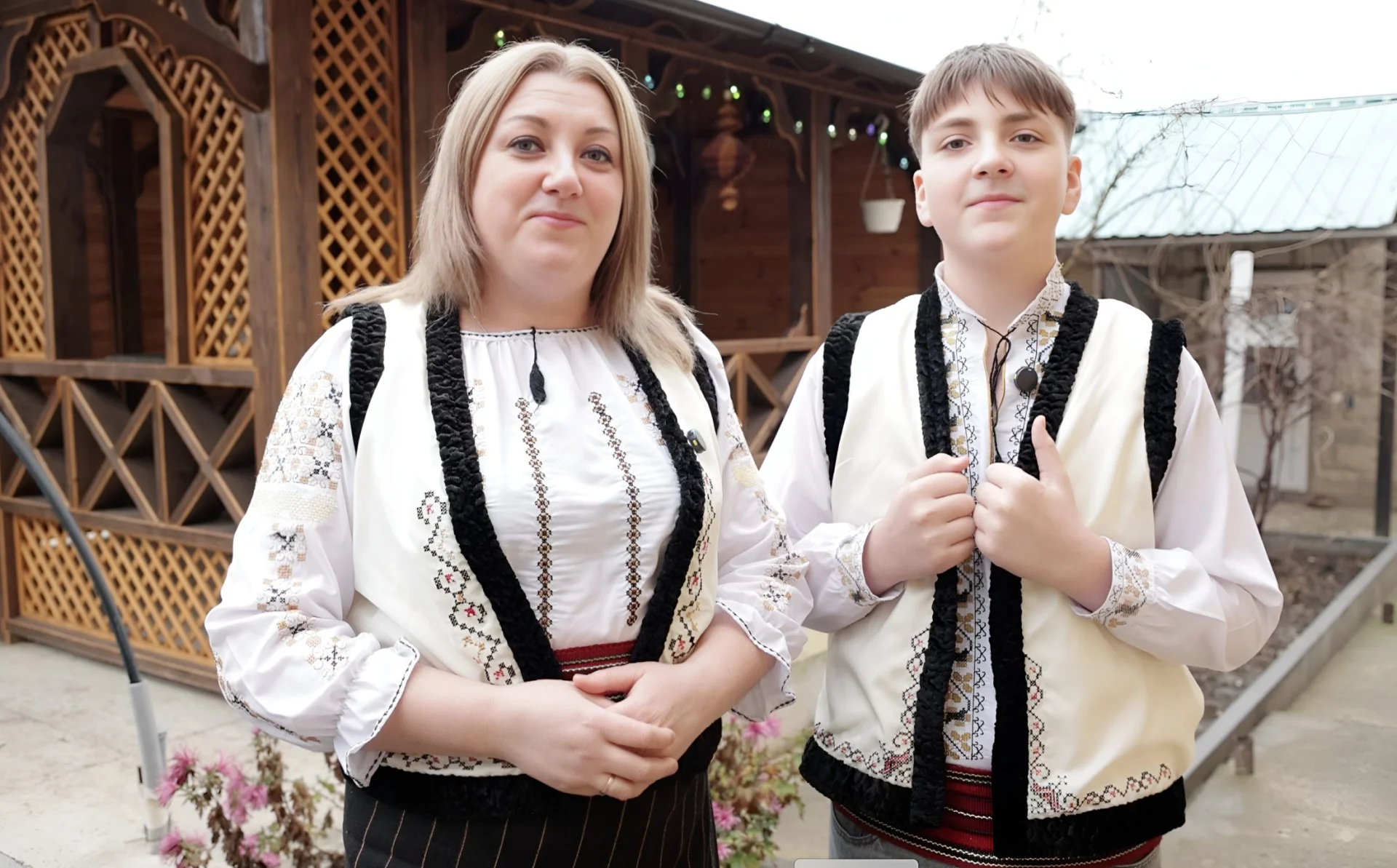
After the the Scripcaru family, we go to a neighboring village, in the same commune. In Semeni, the Cimpoeș family is waiting for us: the mother Maria and two of her children, Rafael and Tatiana.
It is Sunday and almost the whole family is at home; only the eldest son is in Chișinău, where he is studying medicine.
For 18 years, Maria has been a nurse at the Ungheni district hospital, after graduating from the medical college in the same city. “I love my profession, I practice it with dedication and empathy toward any person in suffering,” Maria says.

Rafael attends the ‘Unghenenii’ dance group, and Tatiana plays the piano.
“I like to dance, to promote the traditions of the Republic of Moldova, of our people. We went to Romania for various competitions; there I saw a country much more developed than ours,” Rafael explained.
“I see my future at home as well,” says Tatiana, who also practices folk dance.
Their mother, Maria, says that through her children’s artistic activities she often goes to Romania, and speaks about the renovation of the Ungheni Palace of Culture, “which is a benefit for children, so that they have better conditions”.
She lists several projects carried out with the help of EU funds, but says that Moldova also has something to offer the community.
“Beautiful people, both in appearance and in soul, as well as the values we hold and preserve,” she says.

Caught between past and present
The “European dream” fades, however, the closer you get to the other end of the country. In 2025, Moldova’s democracy was put to the test. Despite the eventual victory of pro-European forces, Russian disinformation relentlessly promoted divisive issues and narratives. Investigative media in Chișinău uncovered entire networks of accounts with fake identifiers spreading Russian propaganda on Telegram, TikTok, and Facebook.
Indeed, from north to south, the Republic of Moldova looks very different: there are communities where Romanian is spoken, and others where Russian, Ukrainian, or Gagauz are used. Given the complexity of the situation, people may rely on different sources of information.
Even in Chișinău, the country’s capital, older people are also less willing to be photographed and to answer questions, while young people are more open, as shown by a HotNews field report.
“It would be great to join the European Union, but in our reality the EU does not need us. The situation in the country right now is such that we do not even have decent housing, jobs are poorly paid, prices are rising, fuel is becoming more expensive – everything is getting more expensive. I’m not even talking about education. I am a student, and it’s just madness,” said one young man, expressing his opinion.
In the village of Naslavcea, the northernmost settlement in the country, on the border with Ukraine, people look at journalists with suspicion, do not want to talk, and are afraid that they could get into trouble if they express their true opinions. Many residents have relatives both in Ukraine and in Russia.
Situated more than 200 kilometers from Chișinău, on the bank of the Dniester, the locality has fewer than 800 people, who speak almost exclusively Russian.
Nelya, 51, says she is Ukrainian, but her sister lives in Russia, where “life is better than in Moldova, because there are good jobs and salaries”. That is why Nelya sees no point in the Republic of Moldova joining the European Union.
“Life was more stable during Soviet times,” says another resident, Valeria, 45.
Another local resident, Natalia, was afraid to answer questions related to the political situation in Moldova. “Tomorrow the police will come if I say something wrong to you,” she says, adding that her family is from Belarus.
And the government in Chișinău is not popular in this village. This much was clear from by the results of both the presidential and parliamentary elections. With high levels of poverty in the region, people resented government pleas not to take money in exchange for voting for a pro-Russian forces. “People took the money out of poverty and need. That’s life,” said one a retired woman, explaining local people’s willingness to sell their votes.
But one a resident in Naslavcea said he had once worked in the EU. “There we earn more in a day than here in a month,” he said. He would like Moldovans to have the opportunity to work anywhere in the EU.
Author: Oxana Bodnar
The original story was published in Romanian by HotNews.ro