Celebrate the European Languages Day with us
Every year on 26 September, Europe celebrates linguistic diversity and the courage it takes to say your first words in a new language. The European Day Languages Day reminds us that languages are not just tools for communication — they are also different ways of understanding the world.
The European Day of Languages was launched as part of the European Year of Languages 2001, organised by the Council of Europe and the European Union. Following the success of the campaign, the Council of Europe established 26 September as an annual celebration. Today, the initiative reaches around 700 million people across the 46 member states of the Council of Europe.
The aim of the day is not to promote any one language, but to celebrate Europe’s entire linguistic heritage: official, regional and minority languages, sign languages, as well as languages brought to the continent by migrant communities.
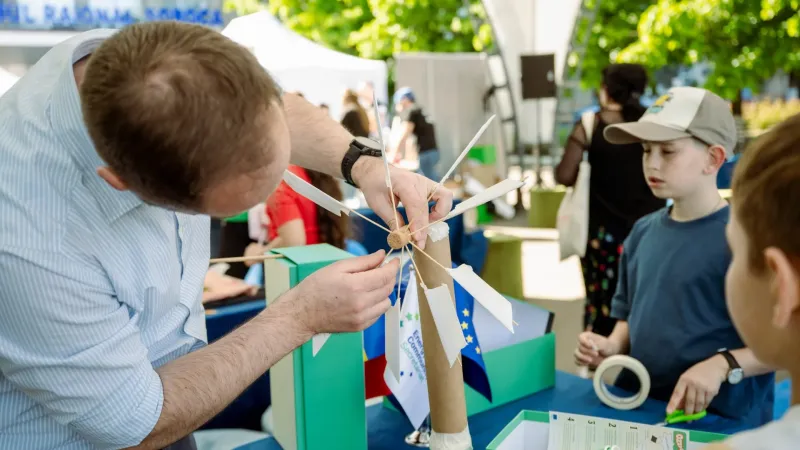
This year, together with young people from the Euro Clubs and EU Information Centres, we will celebrate the European Day of Languages at Vasile Alecsandri High School in Chișinău, with activities, games, competitions and creative performances.
A few interesting facts about the languages of Europe
- Europe is home to around 225 indigenous languages, representing almost 3% of all languages spoken worldwide.
- At least half of the world’s population is bilingual or multilingual.
- The European Union has 24 official languages, written using three alphabets: Latin, Cyrillic and Greek.
- The 24 official EU languages create 552 possible combinations for translation and interpreting.
- A language can have more than 50,000 words, but in everyday conversations, we regularly use only a few hundred.
- Languages do not exist in isolation: they constantly borrow words and expressions from one another.
- Children generally begin saying their first recognisable words at around one year old, and by the age of five, they may already know several thousand words.
- You do not have to speak a language perfectly to be multilingual. Even being able to communicate at a basic level in several languages counts.
Learning a foreign language develops much more than vocabulary. It opens the door to other cultures, makes education and professional mobility easier, and helps us communicate with greater empathy.
On the European Day of Languages, the challenge can be simple: learn a new phrase, listen to a song in an unfamiliar language, or start a conversation you have not had the courage to begin until now. Sometimes, bringing people closer starts with just one word.